
“I think it is criminal that we ( writers ) are not permitted to make dramatic note of social evils that exist, of controversial themes as they are inherent in our society.”
Rod Serling
 Last year I was faced with a decision- post a Press Release on my blog about I.C.E. Agents making an appearance in Lynnwood, Washington or use the Press Release as the basis for a story.
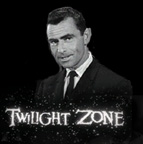
I learned how to write like that from Rod Serling.
I caught on to the fact that as a writer you could be as Political as the day is long and not cause too grief to yourself and others – providing of course the ideas you were expressing were wrapped in a black cape and had fangs. However, being that my husband and I are both Political Activists guess which route I took?
It’s a cliche’ but sometimes you do have to decided which hill to die on.
Only right in the middle of drafting a Vampire Story based on the press release I wondered what would Rod Serling say about my decision and I thought he’d say: “Hell Anita, this is 2007, what are you doing? We had something called the Civil Rights Movement– and the Women’s Liberation movement…a lot of people walked a very long way to change our our world. “
So I slammed on my breaks, took a sharp turn and ” Started my way down an unmarked road- the kind of road that can only be found in…
The Twilight Zone.”
Since then my blogs- one of which is full of my own ” Twilight Zone ” type stories and other which was at the time a daily journal that was NOT political has been visited by Homeland Security, The Pentagon and other Government agencies.
These agencies have gone over stories I’ve written about Vampires, Werewolves, cursed towns and people getting buried alive- (for some strange reason the Pentagon seemed fond of visiting a Halloween Greeting I did for my readers with the quote: “From ghoulies and ghosties and long leggety beasties and things that go bump in the night, Good Lord, deliver us!” )
Along with my new Official Type Readers ( who could spend anywhere from 5 minutes to a half hour on one site ) I received e-mails from an employee of a local law enforcement agency calling me a fascist for not running his comments and fake name ( which was misspelled ) on one of the posts and argued his point to be read on my blog by REMINDING me that ” We ( the police) allow people we arrest to make a statement that is contrary to our reports” (emphasis and underline by a.m.m)
What I realized after I received the second e-mail was that my life would not have become somewhat more complicated had I simply taken the I.C.E. Agents and the entire Anti-Mexican issue to the Twilight Zone where I could have turned the entire rotten lot of haters into Monster Hunters and then bumped them all off and then immediately had LOTS AND LOTS readers saying, ” Hurray!” ( it’s all about the under dog nowadays…in case you haven’t noticed, that’s a Twilight Zone thing )
After all that’s what Rod Serling did- some of his stories were designed to survive in a ‘ hostile enviorment’- stories like the one Rod Serling wrote about Emmet Till:
Historians view Till’s case as one of the catalysts of the civil rights movement. Till was a black 14-year-old from Chicago who whistled at a white woman while visiting relatives in Mississippi. The two men accused of kidnapping and brutally murdering Till were acquitted, though they later admitted to the crime… ( AP)
This is the deal: the two versions Rod Serling wrote about Emmet Till (so that Emmet’s story could at least see the light of day), never made Rod Serling or anybody else very happy.
Sitting through those two versions is like listening to a guitar that’s being played slightly out of tune.
That’s why I posted the notices for open public meetings about immigration, the press releases about the I.C.E Agents, and my opinions to what was becoming a despicable situation created by ignorance and intolerance as they stood on my blog.
That was the story and there was no other way to tell it.
So was it worth it?
I guess that having a Law Enforcement person screeching at my husband in a public meeting about immigration- where there are armed enforcement people standing all around the room- that my blogs are somehow causing her and her agency some sort of grief is- in it’s own way- a reward.
That’s why on so many levels- from mine as a Writer, a Human Rights Activist, and as a Political Activist – I’m glad that the story whose message about race and prejudice resurfaced now- and that it has returned from it’s long trip through the Twilight Zone when it did.
It’s time.
amm
Submitted For Your Approval, Finally.
ITHACA, New York (AP) —
More than a half-century after it was twice censored by network television, Rod Serling’s story on the 1955 lynching of Emmett Till and his message about prejudice will finally be told the way Serling wanted.
The original stage script of Serling’s “Noon on Doomsday” will be read Saturday at Ithaca College during a conference on Serling’s life and legacy. The award-winning writer-creator of “The Twilight Zone” taught at Ithaca from 1967 until 1975, when he died.
“Serling seemed to struggle with network and sponsor censorship all his career but I believe his trying to tell the story of the Emmett Till case was the pinnacle of this battle,” said Andrew Polak, the board president of the Rod Serling Memorial Foundation, a Binghamton-based nonprofit group that works to further Serling’s legacy. “This will be the first time the story will be told as Rod intended.”
Historians view Till’s case as one of the catalysts of the civil rights movement. Till was a black 14-year-old from Chicago who whistled at a white woman while visiting relatives in Mississippi. The two men accused of kidnapping and brutally murdering Till were acquitted, though they later admitted to the crime.
Serling tried twice to dramatize Till’s murder and the acquittal of his killers. In both cases, the writer met with sponsor censorship and network interference that diluted his final work, said researchers Tony Albarella and Amy E. Boyle Johnston.
“Serling was one of the first people to write about current events. He was taking a major front-page issue and showing the universal appeal of it and showing our own implications. Today that’s a dime a dozen. But when Serling was doing it, that was shocking,” said Johnston, who’s working on a biography of Serling to be published in 2009.
By the time Till was lynched, Serling was one of the most celebrated writers of TV’s Golden Age and already had written several socially conscious scripts, including “Patterns” (about corporate corruption) and “Requiem for a Heavyweight.” Serling’s Till story was initially accepted and approved by the producers of ABC’s “The United States Steel Hour,” for which he’d already written several well-received scripts.
But when it was reported that Serling was writing about the Till case, thousands of protests poured in, mostly from members of the White Citizens Council, a Southern white supremacist organization, said Johnston.
Serling produced three “Doomsday” scripts. The first two were for the stage, said Johnston. In the original, the victim was a college-aged black man. Serling’s language and descriptions also were more coarse and idiomatic in the original version, she said.
When it ran on television in April 1956, “Noon on Doomsday” was so watered down as to be meaningless, Johnston said.
The location was changed to New England. The murdered person was transformed into an unnamed foreigner. The word “lynch” was excised from the script, as was anything deemed “too Southern” in connotation. The villain was softened to “just a good decent, American boy momentarily gone wrong,” Johnston said.
Two years later, Serling tried again to examine the extreme consequences of prejudice enmeshed in Till’s saga. His new effort was titled “A Town Has Turned to Dust,” and he offered it to CBS for “Playhouse 90.”
But CBS executives again eviscerated the script — changing the central character to a Mexican boy who falls in love from afar with a white shopkeeper’s wife, said Albarella, who’s working on the sixth book of a 10-book series about “The Twilight Zone” called “As Timeless As Infinity.”
Although it received critical acclaim, a dismayed Serling later said, “By the time ‘A Town Has Turned to Dust’ went before the cameras, my script had turned to dust.”
But those experiences, said Polak, help lead Serling to another place — where he was free to explore the darkened human heart by use of allegory and within the context of fantasy: “The Twilight Zone.”






 Irregular Bones