Today while President – born in America so you can go suck his birthcertifate-Obama was discussing Health Care Reform
with
other grownups and sane people in Minnepolis
you guys ran to DC
– while he was out of town-
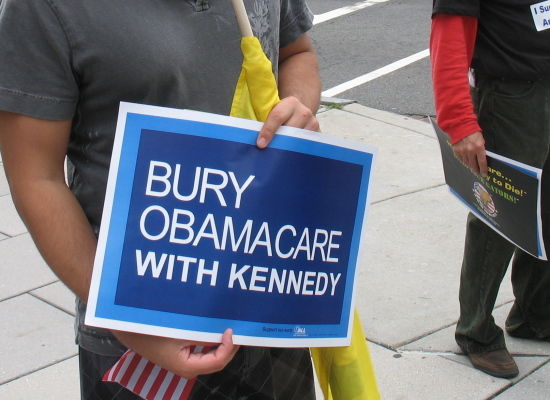
and waved around signs like this one.
At least they spelled all the words right- this time
Is this for real?
I heard that while you were in DC you did fun things like walk around looking at horse poop and while doing that you ‘found’ a picture of President- yes he is a black man– Obama under a pile of it.
Then you called your friends over to it and took a picture.
Seriously.
You guys get off on horse poop?
I’ll be darned
I guess you do….
Teabaggers and Horse Poop.
Still.
There was one picture, one moment that I think really captured what you guys really wanted to tell
President- Lots of White People Voted For Him too so LOL-Obama
and it didn’t have anything to do with Health Care Reform…
did it?
Um..did you leave it back at the trailer park?
I hope you enjoyed your big adventure in
OUR
Nation’s Capital.
Don’t let the door hit you on your butts on the way out
I thought this war of sorts was all about a bunch of Racists hating the fact that they have
an African American President.
They really really hated that, I thought, and their fury at President Obama and anyone who happened to be non-white was unparalleled in
the entire History of Racism.
But I don’t think that’s true anymore.
I think they’re even angrier at the other White People who voted for him.
I think on the hate-o-meter they hate those people more then they hate anyone right now.
It makes sense.
Because if we keep down this road and don’t move forward with Health Care Reform, a lot of white people will not only have a poor quality of life- so will their children.
It also goes without saying that with a poor quality of life comes things like a lower life expectancy. In the mean time your body doesn’t work right, your mind doesn’t reach it’s full potential.
It’s a death sentence of sorts.
And it’s just not being handed down from the GOP and The Talking Heads and the Paid Toads holding mass produced signs in one hand while looking at the Talking Points inked on the palm of their other hand.
It’s being handed down from one neighbor to another.
Think about it.
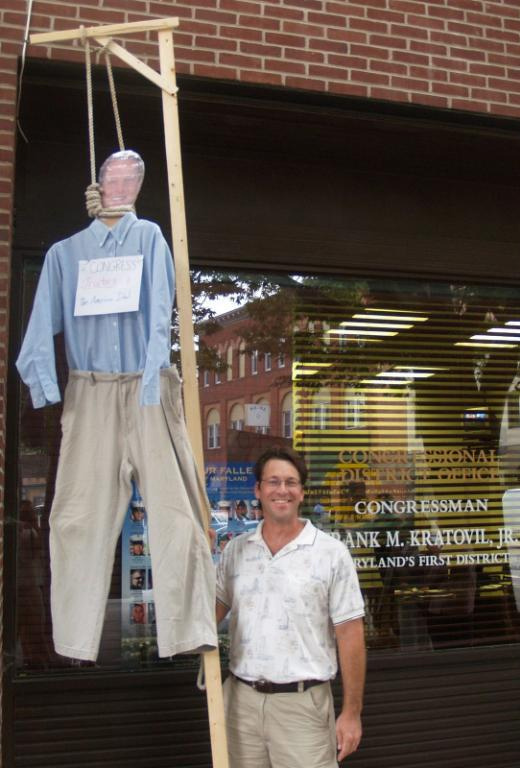
Rep. Kratovil hung in effigy by health care protester
Do you remember what happened to people who did not “respect” the flag, the US Constitution or the status quo back in the day?
Let me refresh your memory:
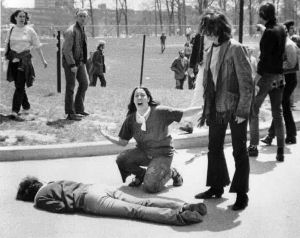
John Filo's iconic Pulitzer Prize-winning photograph of Mary Ann Vecchio, a fourteen-year-old runaway, kneeling over the dead body of Jeffrey Miller after he was shot by the National Guard.
Alabama Protest Against Desegregation.
ST. PAUL, MN - SEPTEMBER 2: A woman is taken into custody by police near the Xcel Energy Center, the site of the 2008 Republican National Convention (RNC) September 2, 2008 in St. Paul, Minnesota. The GOP will nominate U.S. Sen. John McCain (R-AZ) as the Republican choice for U.S. President on the last day of the convention. (Photo by Eric Thayer/Getty Images)
Now days you can get away with showing the same
disrespect….
assuming of course you have an elected offiical
from
The Republican Party at your side like this young woman
A conspiracy theorist who believes that Barack Obama is ineligible for the Presidency of the United States, based on any number of claims related to his place of birth, birth certificate, favorite birthday, or whether or not he has heard the song Africa by Toto.
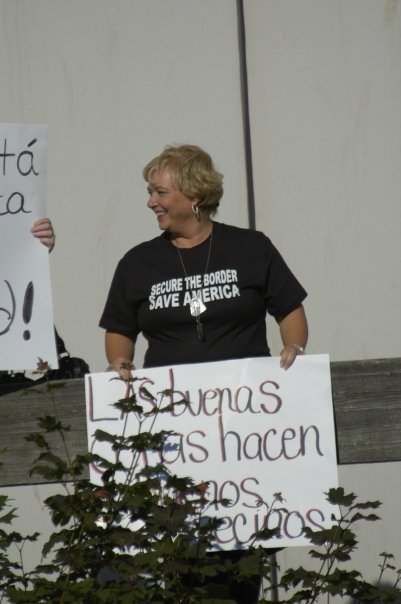
Letter to the Everett Herald written by my husband in regards to Extremists like Shawna Forde
EXTREMISTS
Commission’s outreach needed
The editorial headline in Friday’s Herald had it right when it stated that threats mustn’t be dismissed because
“…we can’t count on white supremacists, and other extremists, to get themselves arrested before they do harm.”
Two years ago Shawna Forde publicly exposed her extremist beliefs when she organized an “anti-immigrant summit” at the Everett Elks Lodge. Her subsequent trouble with the law and personal difficulties are well documented by this newspaper, the blogosphere and her own Web site.
On Friday we learned that she had been arrested in Arizona and is charged with murder in connection with the shooting deaths of a 9-year-old Mexican American girl and her father in Pima County. Was this the inevitable outcome of a life filled with fear and hate? What could we have done differently in Snohomish County to, perhaps, help avert the unfortunate series of events in this woman’s life?
One way to reach out to all residents and communities in Snohomish County would be through an educational outreach program now being considered by the Snohomish County Council. The council is reviewing an ordinance submitted to it last year by the Snohomish County Citizens Committee for Human Rights (www.sccchr.org).
The SCCCHR is requesting that the council establish a Human Rights Commission based on the Washington State Human Rights Commission. The state commission was instrumental in the development of the ordinance with the help of over 50 volunteer citizens throughout the county. It has been endorsed by numerous organizations, elected officials and individuals.
This ordinance would be the first county-led effort of a county-wide program to identify and address human and civil rights issues in Snohomish County. Snohomish County is currently the largest county in Washington without a Human Rights Commission.
It’s time that we acknowledge and deal with perceived and real “threats” when they occur in our own county while we mourn the tragedy allegedly caused by one of our citizens in another.
If Caribou Barbie wants to go there…let’s go there.
Let’s talk.
Let’s talk about YOU Caribou Barbie
Palling Around With Secessionists
Sarah Palin and the Alaska Independence Party.
Palin addresses Alaska Independence Party convention
“I share your party’s vision of upholding the constitution of our great state “( Note PALIN DOES NOT SAY U.S. CONSTITUTION BUT THE ALASKA STATE CONSTITUTION)
Sarah Palin and the Witch Hunter back in the News
Countdown Special Comment on Sarah Palin’s Hysteria
Along the comment on Caribou Barbie there is a story in this about a woman named Addie Polk, 90, of Akron, Ohio. You need to know this story.
Reactions from Palin / McCain Rally
from the Huffington Post
At a McCain rally on Monday, television stations caught audio of a crowd member calling Obama a “terrorist,”while Dana Milbank reported that “[o]ne Palin supporter shouted a racial epithet at an African American sound man for a network and told him, ‘Sit down, boy.'” Also on Monday, at a Palin rally, one member of the audience yelled, “Kill him!“
“I think it is criminal that we ( writers ) are not permitted to make dramatic note of social evils that exist, of controversial themes as they are inherent in our society.”
Rod Serling
Last year I was faced with a decision- post a Press Release on my blog about I.C.E. Agents making an appearance in Lynnwood, Washington or use the Press Release as the basis for a story.
I learned how to write like that from Rod Serling.
I caught on to the fact that as a writer you could be as Political as the day is long and not cause too grief to yourself and others – providing of course the ideas you were expressing were wrapped in a black cape and had fangs. However, being that my husband and I are both Political Activists guess which route I took?
It’s a cliche’ but sometimes you do have to decided which hill to die on.
Only right in the middle of drafting a Vampire Story based on the press release I wondered what would Rod Serling say about my decision and I thought he’d say: “Hell Anita, this is 2007, what are you doing? We had something called the Civil Rights Movement– and the Women’s Liberation movement…a lot of people walked a very long way to change our our world. “
So I slammed on my breaks, took a sharp turn and ” Started my way down an unmarked road- the kind of road that can only be found in…
The Twilight Zone.”
Since then my blogs- one of which is full of my own ” Twilight Zone ” type stories and other which was at the time a daily journal that was NOT political has been visited by Homeland Security, The Pentagon and other Government agencies.
These agencies have gone over stories I’ve written about Vampires, Werewolves, cursed towns and people getting buried alive- (for some strange reason the Pentagon seemed fond of visiting a Halloween Greeting I did for my readers with the quote: “From ghoulies and ghosties and long leggety beasties and things that go bump in the night, Good Lord, deliver us!” )
Along with my new Official Type Readers ( who could spend anywhere from 5 minutes to a half hour on one site ) I received e-mails from an employee of a local law enforcement agency calling me a fascist for not running his comments and fake name ( which was misspelled ) on one of the posts and argued his point to be read on my blog by REMINDING me that ” We ( the police) allow people we arrest to make a statement that is contrary to our reports” (emphasis and underline by a.m.m)
What I realized after I received the second e-mail was that my life would not have become somewhat more complicated had I simply taken the I.C.E. Agents and the entire Anti-Mexican issue to the Twilight Zone where I could have turned the entire rotten lot of haters into Monster Hunters and then bumped them all off and then immediately had LOTS AND LOTS readers saying, ” Hurray!” ( it’s all about the under dog nowadays…in case you haven’t noticed, that’s a Twilight Zone thing )
After all that’s what Rod Serling did- some of his stories were designed to survive in a ‘ hostile enviorment’- stories like the one Rod Serling wrote about Emmet Till:
Historians view Till’s case as one of the catalysts of the civil rights movement. Till was a black 14-year-old from Chicago who whistled at a white woman while visiting relatives in Mississippi. The two men accused of kidnapping and brutally murdering Till were acquitted, though they later admitted to the crime… ( AP)
This is the deal: the two versions Rod Serling wrote about Emmet Till (so that Emmet’s story could at least see the light of day), never made Rod Serling or anybody else very happy.
Sitting through those two versions is like listening to a guitar that’s being played slightly out of tune.
That’s why I posted the notices for open public meetings about immigration, the press releases about the I.C.E Agents, and my opinions to what was becoming a despicable situation created by ignorance and intolerance as they stood on my blog.
That was the story and there was no other way to tell it.
So was it worth it?
I guess that having a Law Enforcement person screeching at my husband in a public meeting about immigration- where there are armed enforcement people standing all around the room- that my blogs are somehow causing her and her agency some sort of grief is- in it’s own way- a reward.
That’s why on so many levels- from mine as a Writer, a Human Rights Activist, and as a Political Activist – I’m glad that the story whose message about race and prejudice resurfaced now- and that it has returned from it’s long trip through the Twilight Zone when it did.
More than a half-century after it was twice censored by network television, Rod Serling’s story on the 1955 lynching of Emmett Till and his message about prejudice will finally be told the way Serling wanted.
The original stage script of Serling’s “Noon on Doomsday” will be read Saturday at Ithaca College during a conference on Serling’s life and legacy. The award-winning writer-creator of “The Twilight Zone” taught at Ithaca from 1967 until 1975, when he died.
“Serling seemed to struggle with network and sponsor censorship all his career but I believe his trying to tell the story of the Emmett Till case was the pinnacle of this battle,” said Andrew Polak, the board president of the Rod Serling Memorial Foundation, a Binghamton-based nonprofit group that works to further Serling’s legacy. “This will be the first time the story will be told as Rod intended.”
Historians view Till’s case as one of the catalysts of the civil rights movement. Till was a black 14-year-old from Chicago who whistled at a white woman while visiting relatives in Mississippi. The two men accused of kidnapping and brutally murdering Till were acquitted, though they later admitted to the crime.
Serling tried twice to dramatize Till’s murder and the acquittal of his killers. In both cases, the writer met with sponsor censorship and network interference that diluted his final work, said researchers Tony Albarella and Amy E. Boyle Johnston.
“Serling was one of the first people to write about current events. He was taking a major front-page issue and showing the universal appeal of it and showing our own implications. Today that’s a dime a dozen. But when Serling was doing it, that was shocking,” said Johnston, who’s working on a biography of Serling to be published in 2009.
By the time Till was lynched, Serling was one of the most celebrated writers of TV’s Golden Age and already had written several socially conscious scripts, including “Patterns” (about corporate corruption) and “Requiem for a Heavyweight.” Serling’s Till story was initially accepted and approved by the producers of ABC’s “The United States Steel Hour,” for which he’d already written several well-received scripts.
But when it was reported that Serling was writing about the Till case, thousands of protests poured in, mostly from members of the White Citizens Council, a Southern white supremacist organization, said Johnston.
Serling produced three “Doomsday” scripts. The first two were for the stage, said Johnston. In the original, the victim was a college-aged black man. Serling’s language and descriptions also were more coarse and idiomatic in the original version, she said.
When it ran on television in April 1956, “Noon on Doomsday” was so watered down as to be meaningless, Johnston said.
The location was changed to New England. The murdered person was transformed into an unnamed foreigner. The word “lynch” was excised from the script, as was anything deemed “too Southern” in connotation. The villain was softened to “just a good decent, American boy momentarily gone wrong,” Johnston said.
Two years later, Serling tried again to examine the extreme consequences of prejudice enmeshed in Till’s saga. His new effort was titled “A Town Has Turned to Dust,” and he offered it to CBS for “Playhouse 90.”
But CBS executives again eviscerated the script — changing the central character to a Mexican boy who falls in love from afar with a white shopkeeper’s wife, said Albarella, who’s working on the sixth book of a 10-book series about “The Twilight Zone” called “As Timeless As Infinity.”
Although it received critical acclaim, a dismayed Serling later said, “By the time ‘A Town Has Turned to Dust’ went before the cameras, my script had turned to dust.”
But those experiences, said Polak, help lead Serling to another place — where he was free to explore the darkened human heart by use of allegory and within the context of fantasy: “The Twilight Zone.”
The men who attached the picture at the bottom of this post to an e-mail as a joke are not sitting in a basement lined with tin foil –
they don’t visit sites like:
CTRL Forums where nobody knows your name
and
they don’t listen to The Conspiracy Channel On Line.
No, the people who passed this picture along via the Internet are NOT sitting in a room with five deadbolts on the door and that door is not monitored by a 24 hour surveillance camera. They are not sleeping on boxes of sardines in crates and their electricity is not provided by a gasoline generator
They are sitting on the Snohomish City Council in Washington State and from their elected positions they say certainly don’t harbor any ill-feelings towards the Hispanics living in our county.
The Diversity Committee of the Snohomish County Democratic Central Committee.
The Diversity Committee of the Snohomish County Democratic Central Committee takes a stand against “white privilege” in our county.
Recently two Snohomish City council members used the Internet in an inappropriate manner and must be held accountable for their actions.
These two members of the council, Council Member Thorndike and Council Member Johnson recently sent an inappropriate email message to another Council Member that was an example of “white privilege”.
“White privilege is the advantages given freely to white people for no other reason than being born with the “right” skin color. If their skin color had not been white, they would not have been making these jokes. This is no way for an American to treat another American.
Mr. Thorndike and Mr. Johnson have left question marks with most people about their decision-making process. If either were my employee, this behavior would not be tolerated. As an elected official, I expect a higher standard of leadership than what they displayed.
It is time that this attitude is removed from our society and the respect of all people be truly adopted.
-Mark Hintz-
Mark is the chair of the Snohomish County Democrats in Washington State. He is also the vice chair of the Washington State Democratic Chairs Organization.
“We the people, in order to form a more perfect union.”
Two hundred and twenty one years ago, in a hall that still stands across the street, a group of men gathered and, with these simple words, launched America’s improbable experiment in democracy. Farmers and scholars; statesmen and patriots who had traveled across an ocean to escape tyranny and persecution finally made real their declaration of independence at a Philadelphia convention that lasted through the spring of 1787.
The document they produced was eventually signed but ultimately unfinished. It was stained by this nation’s original sin of slavery, a question that divided the colonies and brought the convention to a stalemate until the founders chose to allow the slave trade to continue for at least twenty more years, and to leave any final resolution to future generations.
Of course, the answer to the slavery question was already embedded within our Constitution – a Constitution that had at is very core the ideal of equal citizenship under the law; a Constitution that promised its people liberty, and justice, and a union that could be and should be perfected over time.
And yet words on a parchment would not be enough to deliver slaves from bondage, or provide men and women of every color and creed their full rights and obligations as citizens of the United States. What would be needed were Americans in successive generations who were willing to do their part – through protests and struggle, on the streets and in the courts, through a civil war and civil disobedience and always at great risk – to narrow that gap between the promise of our ideals and the reality of their time.
This was one of the tasks we set forth at the beginning of this campaign – to continue the long march of those who came before us, a march for a more just, more equal, more free, more caring and more prosperous America. I chose to run for the presidency at this moment in history because I believe deeply that we cannot solve the challenges of our time unless we solve them together – unless we perfect our union by understanding that we may have different stories, but we hold common hopes; that we may not look the same and we may not have come from the same place, but we all want to move in the same direction – towards a better future for of children and our grandchildren.
This belief comes from my unyielding faith in the decency and generosity of the American people. But it also comes from my own American story.
I am the son of a black man from Kenya and a white woman from Kansas. I was raised with the help of a white grandfather who survived a Depression to serve in Patton’s Army during World War II and a white grandmother who worked on a bomber assembly line at Fort Leavenworth while he was overseas. I’ve gone to some of the best schools in America and lived in one of the world’s poorest nations. I am married to a black American who carries within her the blood of slaves and slaveowners – an inheritance we pass on to our two precious daughters. I have brothers, sisters, nieces, nephews, uncles and cousins, of every race and every hue, scattered across three continents, and for as long as I live, I will never forget that in no other country on Earth is my story even possible.
It’s a story that hasn’t made me the most conventional candidate. But it is a story that has seared into my genetic makeup the idea that this nation is more than the sum of its parts – that out of many, we are truly one.
Throughout the first year of this campaign, against all predictions to the contrary, we saw how hungry the American people were for this message of unity. Despite the temptation to view my candidacy through a purely racial lens, we won commanding victories in states with some of the whitest populations in the country. In South Carolina, where the Confederate Flag still flies, we built a powerful coalition of African Americans and white Americans.
This is not to say that race has not been an issue in the campaign. At various stages in the campaign, some commentators have deemed me either “too black” or “not black enough.” We saw racial tensions bubble to the surface during the week before the South Carolina primary. The press has scoured every exit poll for the latest evidence of racial polarization, not just in terms of white and black, but black and brown as well.
And yet, it has only been in the last couple of weeks that the discussion of race in this campaign has taken a particularly divisive turn.
On one end of the spectrum, we’ve heard the implication that my candidacy is somehow an exercise in affirmative action; that it’s based solely on the desire of wide-eyed liberals to purchase racial reconciliation on the cheap. On the other end, we’ve heard my former pastor, Reverend Jeremiah Wright, use incendiary language to express views that have the potential not only to widen the racial divide, but views that denigrate both the greatness and the goodness of our nation; that rightly offend white and black alike.
I have already condemned, in unequivocal terms, the statements of Reverend Wright that have caused such controversy. For some, nagging questions remain. Did I know him to be an occasionally fierce critic of American domestic and foreign policy? Of course. Did I ever hear him make remarks that could be considered controversial while I sat in church? Yes. Did I strongly disagree with many of his political views? Absolutely – just as I’m sure many of you have heard remarks from your pastors, priests, or rabbis with which you strongly disagreed.
But the remarks that have caused this recent firestorm weren’t simply controversial. They weren’t simply a religious leader’s effort to speak out against perceived injustice. Instead, they expressed a profoundly distorted view of this country – a view that sees white racism as endemic, and that elevates what is wrong with America above all that we know is right with America; a view that sees the conflicts in the Middle East as rooted primarily in the actions of stalwart allies like Israel, instead of emanating from the perverse and hateful ideologies of radical Islam.
As such, Reverend Wright’s comments were not only wrong but divisive, divisive at a time when we need unity; racially charged at a time when we need to come together to solve a set of monumental problems – two wars, a terrorist threat, a falling economy, a chronic health care crisis and potentially devastating climate change; problems that are neither black or white or Latino or Asian, but rather problems that confront us all.
Given my background, my politics, and my professed values and ideals, there will no doubt be those for whom my statements of condemnation are not enough. Why associate myself with Reverend Wright in the first place, they may ask? Why not join another church? And I confess that if all that I knew of Reverend Wright were the snippets of those sermons that have run in an endless loop on the television and You Tube, or if Trinity United Church of Christ conformed to the caricatures being peddled by some commentators, there is no doubt that I would react in much the same way
But the truth is, that isn’t all that I know of the man. The man I met more than twenty years ago is a man who helped introduce me to my Christian faith, a man who spoke to me about our obligations to love one another; to care for the sick and lift up the poor. He is a man who served his country as a U.S. Marine; who has studied and lectured at some of the finest universities and seminaries in the country, and who for over thirty years led a church that serves the community by doing God’s work here on Earth – by housing the homeless, ministering to the needy, providing day care services and scholarships and prison ministries, and reaching out to those suffering from HIV/AIDS.
In my first book, Dreams From My Father, I described the experience of my first service at Trinity:
“People began to shout, to rise from their seats and clap and cry out, a forceful wind carrying the reverend’s voice up into the rafters….And in that single note – hope! – I heard something else; at the foot of that cross, inside the thousands of churches across the city, I imagined the stories of ordinary black people merging with the stories of David and Goliath, Moses and Pharaoh, the Christians in the lion’s den, Ezekiel’s field of dry bones. Those stories – of survival, and freedom, and hope – became our story, my story; the blood that had spilled was our blood, the tears our tears; until this black church, on this bright day, seemed once more a vessel carrying the story of a people into future generations and into a larger world. Our trials and triumphs became at once unique and universal, black and more than black; in chronicling our journey, the stories and songs gave us a means to reclaim memories tha t we didn’t need to feel shame about…memories that all people might study and cherish – and with which we could start to rebuild.”
That has been my experience at Trinity. Like other predominantly black churches across the country, Trinity embodies the black community in its entirety – the doctor and the welfare mom, the model student and the former gang-banger. Like other black churches, Trinity’s services are full of raucous laughter and sometimes bawdy humor. They are full of dancing, clapping, screaming and shouting that may seem jarring to the untrained ear. The church contains in full the kindness and cruelty, the fierce intelligence and the shocking ignorance, the struggles and successes, the love and yes, the bitterness and bias that make up the black experience in America.
And this helps explain, perhaps, my relationship with Reverend Wright. As imperfect as he may be, he has been like family to me. He strengthened my faith, officiated my wedding, and baptized my children. Not once in my conversations with him have I heard him talk about any ethnic group in derogatory terms, or treat whites with whom he interacted with anything but courtesy and respect. He contains within him the contradictions – the good and the bad – of the community that he has served diligently for so many years.
I can no more disown him than I can disown the black community. I can no more disown him than I can my white grandmother – a woman who helped raise me, a woman who sacrificed again and again for me, a woman who loves me as much as she loves anything in this world, but a woman who once confessed her fear of black men who passed by her on the street, and who on more than one occasion has uttered racial or ethnic stereotypes that made me cringe.
These people are a part of me. And they are a part of America, this country that I love.
Some will see this as an attempt to justify or excuse comments that are simply inexcusable. I can assure you it is not. I suppose the politically safe thing would be to move on from this episode and just hope that it fades into the woodwork. We can dismiss Reverend Wright as a crank or a demagogue, just as some have dismissed Geraldine Ferraro, in the aftermath of her recent statements, as harboring some deep-seated racial bias.
But race is an issue that I believe this nation cannot afford to ignore right now. We would be making the same mistake that Reverend Wright made in his offending sermons about America – to simplify and stereotype and amplify the negative to the point that it distorts reality.
The fact is that the comments that have been made and the issues that have surfaced over the last few weeks reflect the complexities of race in this country that we’ve never really worked through – a part of our union that we have yet to perfect. And if we walk away now, if we simply retreat into our respective corners, we will never be able to come together and solve challenges like health care, or education, or the need to find good jobs for every American.
Understanding this reality requires a reminder of how we arrived at this point. As William Faulkner once wrote, “The past isn’t dead and buried. In fact, it isn’t even past.” We do not need to recite here the history of racial injustice in this country. But we do need to remind ourselves that so many of the disparities that exist in the African-American community today can be directly traced to inequalities passed on from an earlier generation that suffered under the brutal legacy of slavery and Jim Crow.
Segregated schools were, and are, inferior schools; we still haven’t fixed them, fifty years after Brown v. Board of Education, and the inferior education they provided, then and now, helps explain the pervasive achievement gap between today’s black and white students.
Legalized discrimination – where blacks were prevented, often through violence, from owning property, or loans were not granted to African-American business owners, or black homeowners could not access FHA mortgages, or blacks were excluded from unions, or the police force, or fire departments – meant that black families could not amass any meaningful wealth to bequeath to future generations. That history helps explain the wealth and income gap between black and white, and the concentrated pockets of poverty that persists in so many of today’s urban and rural communities.
A lack of economic opportunity among black men, and the shame and frustration that came from not being able to provide for one’s family, contributed to the erosion of black families – a problem that welfare policies for many years may have worsened. And the lack of basic services in so many urban black neighborhoods – parks for kids to play in, police walking the beat, regular garbage pick-up and building code enforcement – all helped create a cycle of violence, blight and neglect that continue to haunt us.
This is the reality in which Reverend Wright and other African-Americans of his generation grew up. They came of age in the late fifties and early sixties, a time when segregation was still the law of the land and opportunity was systematically constricted. What’s remarkable is not how many failed in the face of discrimination, but rather how many men and women overcame the odds; how many were able to make a way out of no way for those like me who would come after them.
But for all those who scratched and clawed their way to get a piece of the American Dream, there were many who didn’t make it – those who were ultimately defeated, in one way or another, by discrimination. That legacy of defeat was passed on to future generations – those young men and increasingly young women who we see standing on street corners or languishing in our prisons, without hope or prospects for the future. Even for those blacks who did make it, questions of race, and racism, continue to define their worldview in fundamental ways. For the men and women of Reverend Wright’s generation, the memories of humiliation and doubt and fear have not gone away; nor has the anger and the bitterness of those years. That anger may not get expressed in public, in front of white co-workers or white friends. But it does find voice in the barbershop or around the kitchen table. At times, that anger is exploited by politicia ns, to gin up votes along racial lines, or to make up for a politician’s own failings.
And occasionally it finds voice in the church on Sunday morning, in the pulpit and in the pews. The fact that so many people are surprised to hear that anger in some of Reverend Wright’s sermons simply reminds us of the old truism that the most segregated hour in American life occurs on Sunday morning. That anger is not always productive; indeed, all too often it distracts attention from solving real problems; it keeps us from squarely facing our own complicity in our condition, and prevents the African-American community from forging the alliances it needs to bring about real change. But the anger is real; it is powerful; and to simply wish it away, to condemn it without understanding its roots, only serves to widen the chasm of misunderstanding that exists between the races.
In fact, a similar anger exists within segments of the white community. Most working- and middle-class white Americans don’t feel that they have been particularly privileged by their race. Their experience is the immigrant experience – as far as they’re concerned, no one’s handed them anything, they’ve built it from scratch. They’ve worked hard all their lives, many times only to see their jobs shipped overseas or their pension dumped after a lifetime of labor. They are anxious about their futures, and feel their dreams slipping away; in an era of stagnant wages and global competition, opportunity comes to be seen as a zero sum game, in which your dreams come at my expense. So when they are told to bus their children to a school across town; when they hear that an African American is getting an advantage in landing a good job or a spot in a good college because of an injustice that they themselves never committ ed; when they’re told that their fears about crime in urban neighborhoods are somehow prejudiced, resentment builds over time.
Like the anger within the black community, these resentments aren’t always expressed in polite company. But they have helped shape the political landscape for at least a generation. Anger over welfare and affirmative action helped forge the Reagan Coalition. Politicians routinely exploited fears of crime for their own electoral ends. Talk show hosts and conservative commentators built entire careers unmasking bogus claims of racism while dismissing legitimate discussions of racial injustice and inequality as mere political correctness or reverse racism.
Just as black anger often proved counterproductive, so have these white resentments distracted attention from the real culprits of the middle class squeeze – a corporate culture rife with inside dealing, questionable accounting practices, and short-term greed; a Washington dominated by lobbyists and special interests; economic policies that favor the few over the many. And yet, to wish away the resentments of white Americans, to label them as misguided or even racist, without recognizing they are grounded in legitimate concerns – this too widens the racial divide, and blocks the path to understanding.
This is where we are right now. It’s a racial stalemate we’ve been stuck in for years. Contrary to the claims of some of my critics, black and white, I have never been so naïve as to believe that we can get beyond our racial divisions in a single election cycle, or with a single candidacy – particularly a candidacy as imperfect as my own.
But I have asserted a firm conviction – a conviction rooted in my faith in God and my faith in the American people – that working together we can move beyond some of our old racial wounds, and that in fact we have no choice is we are to continue on the path of a more perfect union.
For the African-American community, that path means embracing the burdens of our past without becoming victims of our past. It means continuing to insist on a full measure of justice in every aspect of American life. But it also means binding our particular grievances – for better health care, and better schools, and better jobs – to the larger aspirations of all Americans — the white woman struggling to break the glass ceiling, the white man whose been laid off, the immigrant trying to feed his family. And it means taking full responsibility for own lives – by demanding more from our fathers, and spending more time with our children, and reading to them, and teaching them that while they may face challenges and discrimination in their own lives, they must never succumb to despair or cynicism; they must always believe that they can write their own destiny.
Ironically, this quintessentially American – and yes, conservative – notion of self-help found frequent expression in Reverend Wright’s sermons. But what my former pastor too often failed to understand is that embarking on a program of self-help also requires a belief that society can change.
The profound mistake of Reverend Wright’s sermons is not that he spoke about racism in our society. It’s that he spoke as if our society was static; as if no progress has been made; as if this country – a country that has made it possible for one of his own members to run for the highest office in the land and build a coalition of white and black; Latino and Asian, rich and poor, young and old — is still irrevocably bound to a tragic past. But what we know — what we have seen – is that America can change. That is true genius of this nation. What we have already achieved gives us hope – the audacity to hope – for what we can and must achieve tomorrow.
In the white community, the path to a more perfect union means acknowledging that what ails the African-American community does not just exist in the minds of black people; that the legacy of discrimination – and current incidents of discrimination, while less overt than in the past – are real and must be addressed. Not just with words, but with deeds – by investing in our schools and our communities; by enforcing our civil rights laws and ensuring fairness in our criminal justice system; by providing this generation with ladders of opportunity that were unavailable for previous generations. It requires all Americans to realize that your dreams do not have to come at the expense of my dreams; that investing in the health, welfare, and education of black and brown and white children will ultimately help all of America prosper.
In the end, then, what is called for is nothing more, and nothing less, than what all the world’s great religions demand – that we do unto others as we would have them do unto us. Let us be our brother’s keeper, Scripture tells us. Let us be our sister’s keeper. Let us find that common stake we all have in one another, and let our politics reflect that spirit as well.
For we have a choice in this country. We can accept a politics that breeds division, and conflict, and cynicism. We can tackle race only as spectacle – as we did in the OJ trial – or in the wake of tragedy, as we did in the aftermath of Katrina – or as fodder for the nightly news. We can play Reverend Wright’s sermons on every channel, every day and talk about them from now until the election, and make the only question in this campaign whether or not the American people think that I somehow believe or sympathize with his most offensive words. We can pounce on some gaffe by a Hillary supporter as evidence that she’s playing the race card, or we can speculate on whether white men will all flock to John McCain in the general election regardless of his policies.
We can do that.
But if we do, I can tell you that in the next election, we’ll be talking about some other distraction. And then another one. And then another one. And nothing will change.
That is one option. Or, at this moment, in this election, we can come together and say, “Not this time.” This time we want to talk about the crumbling schools that are stealing the future of black children and white children and Asian children and Hispanic children and Native American children. This time we want to reject the cynicism that tells us that these kids can’t learn; that those kids who don’t look like us are somebody else’s problem. The children of America are not those kids, they are our kids, and we will not let them fall behind in a 21st century economy. Not this time.
This time we want to talk about how the lines in the Emergency Room are filled with whites and blacks and Hispanics who do not have health care; who don’t have the power on their own to overcome the special interests in Washington, but who can take them on if we do it together.
This time we want to talk about the shuttered mills that once provided a decent life for men and women of every race, and the homes for sale that once belonged to Americans from every religion, every region, every walk of life. This time we want to talk about the fact that the real problem is not that someone who doesn’t look like you might take your job; it’s that the corporation you work for will ship it overseas for nothing more than a profit.
This time we want to talk about the men and women of every color and creed who serve together, and fight together, and bleed together under the same proud flag. We want to talk about how to bring them home from a war that never should’ve been authorized and never should’ve been waged, and we want to talk about how we’ll show our patriotism by caring for them, and their families, and giving them the benefits they have earned.
I would not be running for President if I didn’t believe with all my heart that this is what the vast majority of Americans want for this country. This union may never be perfect, but generation after generation has shown that it can always be perfected. And today, whenever I find myself feeling doubtful or cynical about this possibility, what gives me the most hope is the next generation – the young people whose attitudes and beliefs and openness to change have already made history in this election.
There is one story in particularly that I’d like to leave you with today – a story I told when I had the great honor of speaking on Dr. King’s birthday at his home church, Ebenezer Baptist, in Atlanta.
There is a young, twenty-three year old white woman named Ashley Baia who organized for our campaign in Florence, South Carolina. She had been working to organize a mostly African-American community since the beginning of this campaign, and one day she was at a roundtable discussion where everyone went around telling their story and why they were there.
And Ashley said that when she was nine years old, her mother got cancer. And because she had to miss days of work, she was let go and lost her health care. They had to file for bankruptcy, and that’s when Ashley decided that she had to do something to help her mom.
She knew that food was one of their most expensive costs, and so Ashley convinced her mother that what she really liked and really wanted to eat more than anything else was mustard and relish sandwiches. Because that was the cheapest way to eat.
She did this for a year until her mom got better, and she told everyone at the roundtable that the reason she joined our campaign was so that she could help the millions of other children in the country who want and need to help their parents too.
Now Ashley might have made a different choice. Perhaps somebody told her along the way that the source of her mother’s problems were blacks who were on welfare and too lazy to work, or Hispanics who were coming into the country illegally. But she didn’t. She sought out allies in her fight against injustice.
Anyway, Ashley finishes her story and then goes around the room and asks everyone else why they’re supporting the campaign. They all have different stories and reasons. Many bring up a specific issue. And finally they come to this elderly black man who’s been sitting there quietly the entire time. And Ashley asks him why he’s there. And he does not bring up a specific issue. He does not say health care or the economy. He does not say education or the war. He does not say that he was there because of Barack Obama. He simply says to everyone in the room, “I am here because of Ashley.”
“I’m here because of Ashley.” By itself, that single moment of recognition between that young white girl and that old black man is not enough. It is not enough to give health care to the sick, or jobs to the jobless, or education to our children.
But it is where we start. It is where our union grows stronger. And as so many generations have come to realize over the course of the two-hundred and twenty one years since a band of patriots signed that document in Philadelphia, that is where the perfection begins.
The attacks in this story have been taking place over a two year period. The first version of the story is mine and I’ve edited it to make a point:
SEATTLE — Seattle police are still on the hunt for a man who is accused of groping 21 women over a three-year period. And now police believe the man is getting more violent.
… reports that the man appears to be targeting COLLEGE GIRLS as they walked to and from three CAMPUS PARKING LOTS AFTER CLASSES
Now a story like this would have been all over the Cable News Networks with wall to wall coverage…so why hasn’t that happened?
MIGHT it be because this is the way the story actually reads:
SEATTLE — Seattle police are still on the hunt for a man who is accused of groping 21 women over a three-year period. And now police believe the man is getting more violent.
Our newspaper partner, the Seattle P-I, reports that the man appears to be targeting Asian women as they walk to and from three bus stops in the Beacon Hill area.
~ ~ ~
This was a comment I found on one of the stories and it’s a back-handed one, but given the way the press has ( not ) covered this issue I guess you can see why the Media doesn’t feel there is an audience receptive to this sort of story:
Sounds like a game of
Whoops-There-It-Is…
Only this is no laughing matter. They need to send out some undercover asain (SP by commentator ) cops to catch this creep before he strikes again.








 Last year I was faced with a decision- post a Press Release on my blog about

 Irregular Bones